There's a particular kind of paralysis that comes with writing your about page.
It's not like writing a services page, where at least you know what you're listing. The about page is supposed to be about you, which sounds simple until you're actually sitting there staring at a blinking cursor, trying to figure out how to describe yourself in a way that sounds professional but not stiff, personal but not oversharing, confident but not arrogant.
You write a sentence. Delete it. Write a few lines. Read them back and think you sound like a corporate robot. Or you end up on the other end of it entirely. You've written something, but it's long. Very long. And you're not sure what stays and what goes, or whether any of it is actually what someone visiting your website needs to read.
Either way, this post is for you.
What your about page is actually for
Here's the thing that changes everything: your about page isn't really about you.
It's about you in relation to your client. The person reading it isn't there to learn your life story. They're there to answer one question: can I trust this person with my problem? Everything on the page either helps them answer that question or it doesn't. That's the filter.
This doesn't mean your about page has to be cold or purely professional. Warmth, personality, and personal details do have a place on this page. But they earn that place by building trust or connection with your specific reader, not just by existing.
Think about what someone is actually doing when they click on your about page. They've probably already seen your home page and services page. They're interested. Now they want to know who they're dealing with. They want to feel like they understand you a little – your approach, your values, what it might be like to actually work with you. Give them that, and this page has done its job. Anything else is optional.
What to include on your about page
Relevant experience and credibility belong here, but only the kind that means something to your specific client. If you're a bookkeeper, your qualifications stay. If you're a coach working with new mums, the fact that you've been through that season yourself stays. If you're a VA who has worked exclusively with e-commerce brands for six years, that stays. These things aren't just facts about you. They're signals that you understand the world your client is living in.
Personal details can stay too, but they need to do some actual work. The test is simple: would this come up naturally if you were working with a client? If you're someone who spends every second weekend hiking and camping, and your clients know they'll hear about your latest trip on your next call, that can go on your about page. It's part of who you are in a professional context, not just a fun fact you're rattling off randomly.
The difference between a personal detail that works and one that doesn't is: don't be generic. "I love my dog" is a filler sentence. "My white French Bulldog Maisy is the absolute love of my life and I'm pretty sure she runs the house" is personality. One tells your reader nothing. The other gives them something to hold onto, something that makes you feel like a real person rather than a professional headshot with bullet points underneath.
The same goes for every personal detail you're considering. Generic kills connection. Specific creates it.
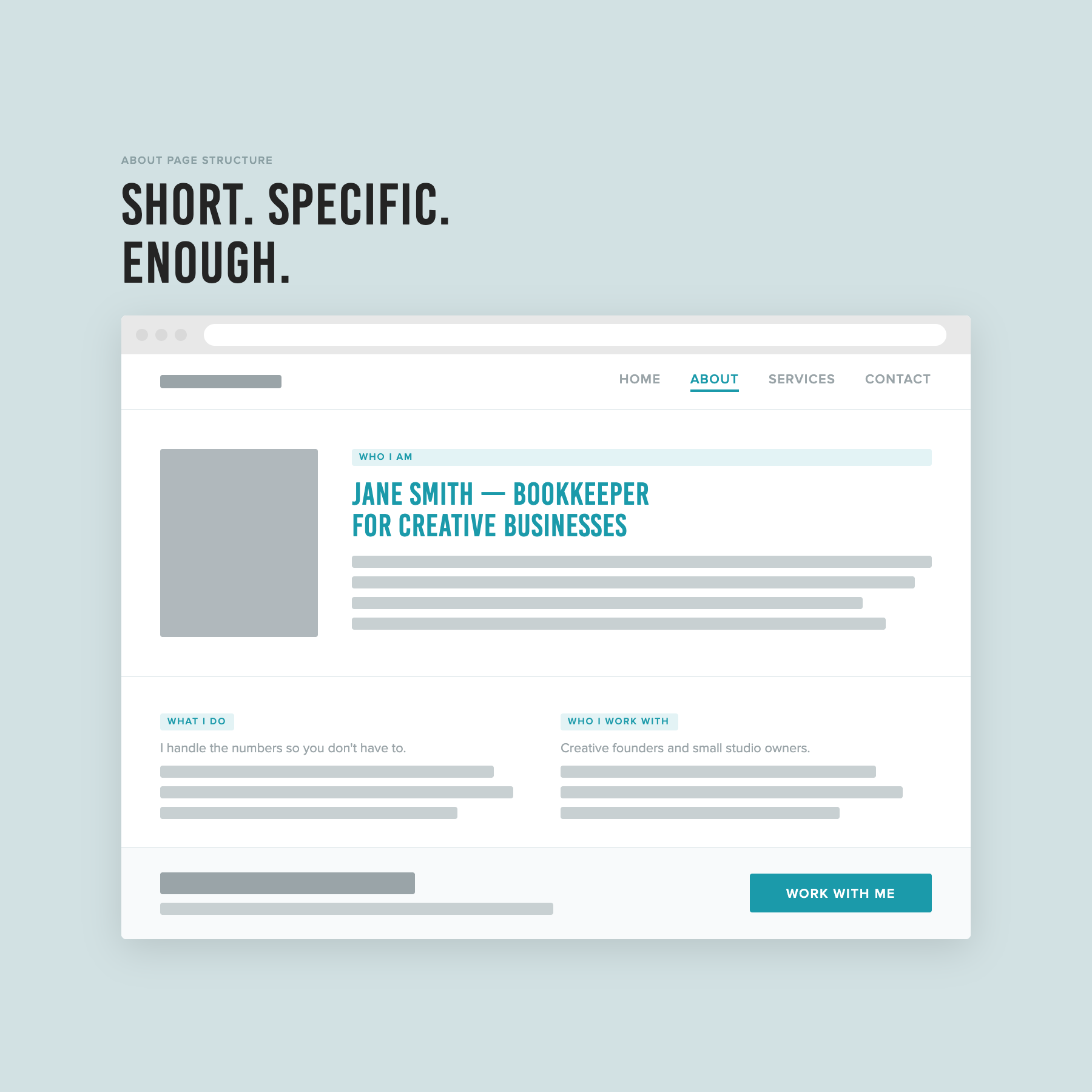
Short, specific, and structured around what your reader actually needs to know.
What to leave off your about page (or where to put it instead)
A lot of service providers, especially those who've built their business online, have a long and winding origin story. They started in one industry, spent years there, had some kind of turning point, tried a few things that didn't work, eventually landed where they are now. It's a real story and often a genuinely interesting one.
But it does not need to live on your about page.
Here's what tends to happen: you write your full timeline, because it feels important to explain how you got here. And suddenly you've got eight pages walking your reader through a career history they didn't ask for, by which point most of them have quietly clicked away.
The about page needs the highlights. The version of your story that is directly relevant to why someone should trust you with their business.
If you have a longer story you want to tell, and honestly some people do and it is worth telling, write it as a blog post. The full origin story, all the context, the real behind-the-scenes of how you got here. Some people will want to read it and it can live on your blog, linked from your about page for anyone who wants to go deeper. But that version doesn't need to be what greets every new visitor.
One practical note: if you're finding it hard to cut, it sometimes helps to write the long version first. Get the whole thing out, every detail, every chapter. It can actually be cathartic. But treat that as a first draft and a future blog post, not the finished page.
Sounding like an actual person
Out of all the pages on your website, your about page is the one where the professional filter can come down the most. Not in terms of content, but in terms of tone. This is where you want to sound the least like a press release and the most like yourself.
The about pages that read as generic almost always have the same problem: they were written the way the person thought they were supposed to write, rather than the way they actually talk. The result is something technically correct and completely forgettable. "I'm passionate about helping my clients achieve their goals." Okay…So is everyone.
If you're struggling to sound like yourself, try this: don't write it, say it. Voice note your answer to the question "so tell me a bit about yourself and your business" as if someone actually asked you that on a discovery call. Get the transcript. That rambling, natural, slightly imperfect version is much closer to what your about page should sound like than anything you'd produce staring at a blank screen trying to write something impressive.
Then edit from there. Tighten it, shape it, make sure the relevant parts are clear. But start from something human.
The short version
Your about page needs to tell your reader who you are in relation to them, give them enough to feel like they know you a little, and make them feel confident enough to take the next step. It does not need your full career history, every qualification you've ever earned, or a list of fun facts that could apply to half the internet.
Include what's relevant. Make it specific. And write it the way you actually talk.
If you want a step-by-step process for setting up your about page alongside the rest of your site, including what content to put where and how to make it all fit together, that's exactly what The Capsule Template walks you through.
This post is part of a series on setting up your service business website. Read the full series: